Wednesday, May 25, 2016

Emperor Xuanzong's reign

Emperor Xuanzong's reign[edit]

The Giant Wild Goose Pagoda,Chang'an (modern-day Xi'an), built in 652, repaired by Empress Wu Zetian in 704.
There were many prominent women at court during and after Wu's reign, including Shangguan Wan'er (664–710), a poetess, writer, and trusted official in charge of Wu's private office.[38] In 706 the wife of Emperor Zhongzong of Tang, Empress Wei (d. 710), persuaded her husband to staff government offices with his sister and her daughters, and in 709 requested that he grant women the right to bequeath hereditary privileges to their sons (which before was a male right only).[39] Empress Wei eventually poisoned Zhongzong, whereupon she placed his fifteen-year-old son upon the throne in 710.[40] Two weeks later, Li Longji (the later Emperor Xuanzong) entered the palace with a few followers and slew Empress Wei and her faction.[40] He then installed his father Emperor Ruizong (r. 710–712) on the throne.[40] Just as Emperor Zhongzong was dominated by Empress Wei, so too was Ruizong dominated by Princess Taiping.[41] This was finally ended when Princess Taiping's coup failed in 712 (she later hanged herself in 713) and Emperor Ruizong abdicated to Emperor Xuanzong.[40][39]
During the 44-year reign of Emperor Xuanzong, the Tang dynasty reached its height, a golden age with low economic inflation and a toned down lifestyle for the imperial court.[42][37] Seen as a progressive and benevolent ruler, Xuanzong even abolished the death penalty in the year 747; all executions had to be approved beforehand by the emperor himself (these were relatively few, considering that there were only 24 executions in the year 730).[43] Xuanzong bowed to the consensus of his ministers on policy decisions and made efforts to staff government ministries fairly with different political factions.[41] His staunch Confucian chancellor Zhang Jiuling (673–740) worked to reduce deflation and increase the money supply by upholding the use of private coinage, while his aristocratic and technocratic successorLi Linfu (d. 753) favored government monopoly over the issuance of coinage.[44] After 737 most of Xuanzong's confidence rested in his long-standing chancellor Li Linfu, who championed a more aggressive foreign policy employing non-Chinese generals. This policy ultimately created the conditions for a massive rebellion against Xuanzong.[45]

The period of the Tang Dynasty (618 to 907)


Tang Dynasty mechanical clock.jpg

The period of the Tang Dynasty (618 to 907) was also known as the “Golden Age” in the history of China.
Tang emperors expanded their influence in to Central and Southeast Asia, demanding tributes from places such as Korea and Vietnam. The Tang era combined aggressive military and economic expansions with political stability and cultural achievement.

Commerce and Economic Development

Trade within the cities and other countries flourished during the Tang Dynasty. The merchants flocked to the large walled cities - such as Chang-an – which became the center of trade. The Silk Road was at its peak providing economic benefits between the East and the West.
Thousands of foreign merchants lived in Chang-an and other large cities of the empire. The profitable relationship between the foreign traders and Chinese traders improved the economy of the empire during Tang Dynasty.

rtistic and Cultural Achievements

The Tang era is notable for its great material prosperity and its high artistic and cultural achievements. The poets and the painters of this Chinese empire produced beautiful and lasting works. The most remarkable literary development was seen in poetry. Several famous poets from the Tang Dynasty created masterpieces that were representative of Chinese literature.

Other Major Achievements

The Tang Dynasty also contributed to the development of medicine, astronomy, and printing techniques. It also marked the development of new technologies and techniques that led to the increase in agricultural production.
During this era, three major tools were either invented or improved upon to help in rice cultivation - the harrow, the chain with paddles (which allows water to be transferred), and the rice field plough. Techniques such as planting out seedlings rapidly increased yield as well.
Tang Dynasty physicians also developed a smallpox vaccine in the 10th century. Tang scientists invented gun powder and mechanical clocks. They also started using block printing during the 8th century.


Although she entered Emperor Gaozong's court as the lowly consort Wu Zhao, Wu Zetian rose to the highest seat of power in 690, establishing the short-lived Wu Zhou. Empress Wu's rise to power was achieved through cruel and calculating tactics: a popular conspiracy theory stated that she killed her own baby girl and blamed it on Gaozong's empress so that the empress would be demoted.[27] Emperor Gaozong suffered a stroke in 655, and Wu began to make many of his court decisions for him, discussing affairs of state with his councilors, who took orders from her while she sat behind a screen.[28] When Empress Wu's eldest son, the crown prince, began to assert his authority and advocate policies opposed by Empress Wu, he suddenly died in 675. Many suspected he was poisoned by Empress Wu. Although the next heir apparent kept a lower profile, in 680 he was accused by Wu of plotting a rebellion and was banished. (He was later obliged to commit suicide.)[29]
In 683, Emperor Gaozong died. He was succeeded by Emperor Zhongzong, his eldest surviving son by Wu. Zhongzong tried to appoint his wife's father as chancellor: after only six weeks on the throne, he was deposed by Empress Wu in favor of his younger brother, 12-year-old Emperor Ruizong.[29] This provoked a group of Tang princes to rebel in 684; Wu's armies suppressed them within two months.[29] She proclaimed the Tianshou era of Wu Zhou on October 16, 690,[30] and three days later demoted Emperor Ruizong to crown prince.[31] He was also forced to give up his father's surname Li in favor of the empress's Wu.[31] She then ruled as China's only empress. A palace coup on February 20, 705, forced her to yield her position on February 22. The next day, her son Zhongzong was restored to power; the Tang was formally restored on March 3. She died soon after.[32] To legitimize her rule, she circulated a document known as the Great Cloud Sutra, which predicted that a reincarnation of the Maitreya Buddha would be a female monarch who would dispel illness, worry, and disaster from the world.[33][34] She even introduced numerous revised written characters to the written language, which reverted to the originals after her death.[35] Arguably the most important part of her legacy was diminishing the power of the northwest aristocracy, allowing people from other clans and regions of China to become more represented in Chinese politics and government.[36][37]


Tang dynasty


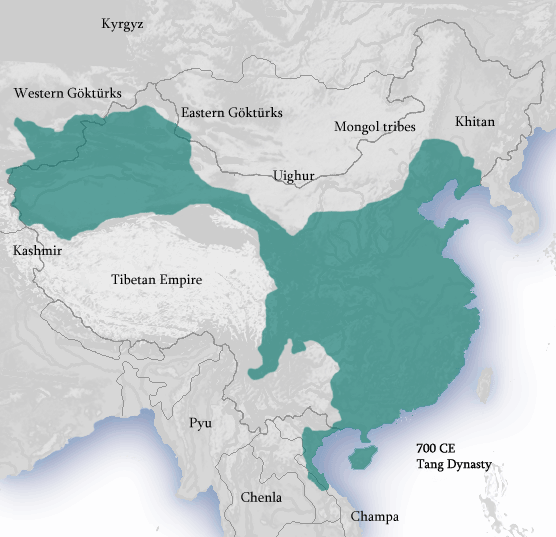
File:Tang Dynasty circa 700 CE.png


The Tang dynasty (Chinese)[a] was an imperial dynasty of China preceded by the Sui dynasty and followed by the Five Dynasties and Ten Kingdoms period. It is generally regarded as a high point in Chinese civilization, and a golden age of cosmopolitan culture.[3] Its territory, acquired through the military campaigns of its early rulers, rivaled that of the Han dynasty, and the Tang capital at Chang'an (present-day Xi'an) was the most populous city in the world.
The dynasty was founded by the  family (李), who seized power during the decline and collapse of the Sui Empire. The dynasty was briefly interrupted when Empress Wu Zetian seized the throne, proclaiming the Second Zhou dynasty (690–705) and becoming the only Chinese empress regnant. In two censuses of the 7th and 8th centuries, the Tang records estimated the population by number of registered households at about 50 million people.[4][5] Yet, even when the central government was breaking down and unable to compile an accurate census of the population in the 9th century, it is estimated that the population had grown by then to about 80 million people.[6][7][b] With its large population base, the dynasty was able to raise professional and conscripted armies of hundreds of thousands of troops to contend with nomadic powers in dominating Inner Asia and the lucrative trade routes along the Silk RoadVarious kingdoms and states paid tribute to the Tang court, while the Tang also conquered or subdued several regions which it indirectly controlled through a protectorate system. Besides political hegemony, the Tang also exerted a powerful cultural influence over neighboring states such as those in Korea, Japan, and Vietnam.
The Tang dynasty was largely a period of progress and stability in the first half of the dynasty's rule, until the An Lushan Rebellion and the decline of central authority in the later half of the dynasty. Like the previous Sui dynasty, the Tang dynasty maintained a civil service system by recruiting scholar-officials through standardized examinations and recommendations to office. This civil order was undermined by the rise of regional military governors known as jiedushi during the 9th century. Chinese culture flourished and further matured during the Tang era; it is considered the greatest age for Chinese poetry.[8] Two of China's most famous poets, Li Bai and Du Fu, belonged to this age, as did many famous painters such as Han GanZhang Xuan, andZhou Fang. There was a rich variety of historical literature compiled by scholars, as well as encyclopedias and geographical works. The adoption of the title Tängri Qaghan by the Tang Emperor Taizong in addition to his title as emperor was eastern Asia's first "simultaneous kingship".[9]
There were many notable innovations during the Tang, including the development of woodblock printingBuddhism became a major influence in Chinese culture, with native Chinese sects gaining prominence. However, Buddhism would later be persecuted by the state, subsequently declining in influence. Although the dynasty and central government were in decline by the 9th century, art and culture continued to flourish. The weakened central government largely withdrew from managing the economy, though the country's mercantile affairs stayed intact and commercial trade continued to thrive regardless, at least until agrarian rebellions in the latter half of the 9th century brought the dynasty to its knees, resulting in damaging atrocities such as theGuangzhou Massacre.

Sui dynasty Chinese history

Sui dynasty


Chinese historySui dynastyWade-Giles romanization Sui, 
bodhisattva [Credit: Photograph by Jenny O’Donnell. Indianapolis Museum of Art, gift of Mr. and Mrs. Eli Lilly, 60.47](581–618 ce), short-lived Chinese dynasty that unified the country after four centuries of fragmentation in which North and South China had gone quite different ways. The Sui also set the stage for and began to set in motion an artistic and cultural renaissance that reached its zenith in the succeeding Tang dynasty (618–907). Its capital was at Daxing, which, during Tang times, changed its name to Chang’an (now Xi’an).
The first Sui emperor, Yang Jian, known by his posthumous name Wendi, was a high official of the Bei (Northern) Zhou dynasty (557–581), and, when that reign dissolved in a storm of plots and murders, he managed to seize the throne and take firm control of North China; by the end of the 580s he had won the West and South and ruled over a unified China. The Wendi emperor established uniform institutions of government throughout the country and raised a corps of skilled and pragmatic administrators. He reestablished Confucian rituals last used in government by the Han dynasty. He sought and won the support of men of letters, and he fostered Buddhism. He promulgated a penal code and administrative laws that were simpler, fairer, and more lenient than those of the predecessor Bei Zhou. He conducted a careful census, a practice long lost in chaos, and simplified the taxation. He made his army into a system of militias that was self-supporting when the country was not at war.
The second emperor, Yangdi, completed the integration of southern China into the empire, emphasized the Confucian Classics in an examination system for public employment, and built a second capital at Luoyang in the east. He engaged in great construction projects, including a vast canal system.
The relations of the Sui with the Turks in the west deteriorated; and, when wars in Korea to exact tribute failed, the short regime collapsed in a welter of rebellions. Yangdi was murdered by a member of his entourage in 618, and his successor, Gongdi, reigned less than a year.
The architecture of the Sui was dominated by the great Yuwen Kai, who in nine months designed a vast capital city at Daxing that was six times the size of present-day Xi’an at the same site. Its palace had a rotating pavilion accommodating 200 guests. Painters came from throughout the country seeking patronage at the Sui court. The dynasty established a pattern of patronizing the arts that was later embraced by the Tang rulers. Because of the brevity of the Sui reign and the consonance of its arts with those of the Tang, the arts of the two dynasties are often treated together.


he Li family belonged to the northwest military aristocracy prevalent during the Sui dynasty[10][11]and claimed to be paternally descended from the Daoist founder Laozi (whose personal name was Li Dan or Li Er),[12] the Han dynasty General Li Guang,[13][14] and Western Liang ruler Li Gao. This family was known as the Longxi Li lineage (隴西李氏) which includes Li Bai. The Tang Emperors had Xianbei maternal ancestry,[15][16] from Emperor Gaozu of Tang's Xianbei mother Duchess Dugu.
Li Yuan was Duke of Tang and governor of Taiyuan during the Sui dynasty's collapse, which was caused in part by the Sui failure to conquer the northern part of the Korean peninsula during theGoguryeo–Sui War.[10][17] He had prestige and military experience, and was a first cousin of Emperor Yang of Sui (their mothers were sisters).[4] Li Yuan rose in rebellion in 617, along with his son and his equally militant daughter Princess Pingyang (d. 623), who raised and commanded her own troops.[18]In winter 617, Li Yuan occupied Chang'an, relegated Emperor Yang to the position of Taishang Huang or retired emperor, and acted as regent to the puppet child-emperor, Emperor Gong of Sui.[18]On the news of Emperor Yang's murder by General Yuwen Huaji on June 18, 618, Li Yuan declared himself the emperor of a new dynasty, the Tang.[18][19]
Li Yuan, known as Emperor Gaozu of Tang, ruled until 626, when he was forcefully deposed by his son Li Shimin, the Prince of Qin. Li Shimin had commanded troops since the age of 18, had prowess with bow and arrowsword and lance and was known for his effective cavalry charges.[4][20] Fighting a numerically superior army, he defeated Dou Jiande (573–621) at Luoyang in the Battle of Hulao on May 28, 621.[21][22] In a violent elimination of royal family due to fear of assassination, Li Shimin ambushed and killed two of his brothers, Li Yuanji (b. 603) and Crown prince Li Jiancheng (b. 589), in the Xuanwu Gate Incident on July 2, 626.[23] Shortly thereafter, his father abdicated in his favor and Li Shimin ascended the throne. He is conventionally known by his temple name Taizong.
Emperor Taizong (r. 626–649) receives Gar Tongtsen Yülsung, ambassador of Tibet, at his court; painted in 641 by Yan Liben (600–673)
Although killing two brothers and deposing his father contradicted the Confucian value of filial piety,[23] Taizong showed himself to be a capable leader who listened to the advice of the wisest members of his council.[4] In 628, Emperor Taizong held a Buddhist memorial service for the casualties of war, and in 629 he had Buddhist monasteries erected at the sites of major battles so that monks could pray for the fallen on both sides of the fight.[24] This was during the campaign against Eastern Tujue, a Göktürk khanate that was destroyed after the capture of its ruler, Illig Qaghan, by the famed Tang military officer Li Jing (571–649), who later became a Chancellor of the Tang dynasty. With this victory, the Turks accepted Taizong as their khagan, a title rendered as Tian Kehan (天可汗) in addition to his rule asEmperor of China under the traditional title "Son of Heaven".[25][26]


Conquest of the Western Turksin china


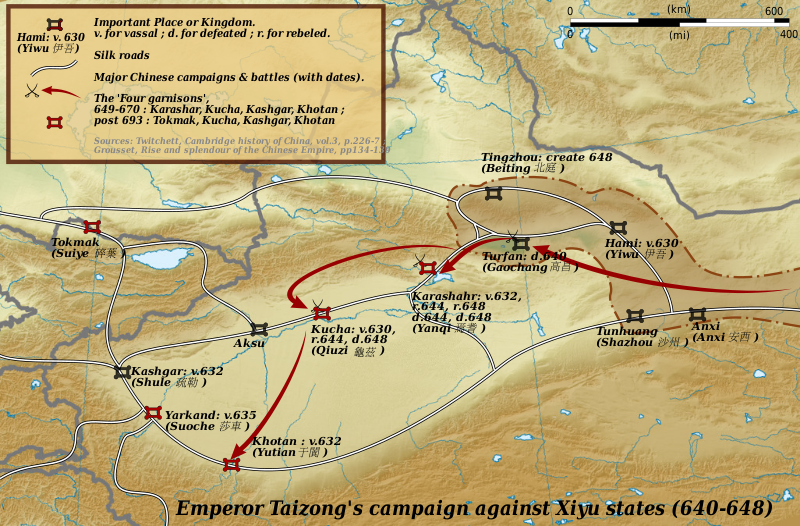
File:Emperor Taizong's campaign against Xiyu states.svg


he conquest of the Western Turks, known as the Western Tujue in Chinese sources, was a military campaign in 657 led by the Tang Dynasty general Su Dingfang against the Western Turkic Khaganate ruled by Ashina Helu. The Chinese war against the Western Turks began in 640 with the annexation of the Tarim Basin oasis state Gaochang, an ally of the Western Turks. Several of the oasis states had once been vassals of the Tang Dynasty, but switched their allegiance to the Western Turks when they grew suspicious of the military ambitions of the Tang. Tang expansion into Central Asia continued with theconquest of Karasahr in 644 and Kucha in 648. Su Dingfang commanded the main army dispatched against the Western Turks, while the Turkic generals Ashina Mishe and Ashina Buzhen led the side divisions. The Tang troops were reinforced by cavalry supplied by the Uyghurs, a tribe that had been allied with the Tang since their support for the Uyghur revolt against the Xueyantuo. Su Dingfang's army defeated Helu at the battle of Irtysh River.
The victory strengthened Tang control of the Western Regions, now modern Xinjiang, and brought the regions formerly ruled by the Khaganate into the Tang empire. Puppet qaghans, the Turkic title for ruler, and military garrisons were installed to administer the newly acquired territories. The Tang Dynasty achieved its maximum extent as China's western borders reached the eastern frontier of the Arabic Umayyad Caliphate. Later on, Turkic revolts ended Chinese hegemony beyond thePamir Mountains in modern Tajikistan and Afghanistan, but a Tang military presence remained in Dzungaria and the Tarim Basin. Central Asia absorbed cultural influences from the conflict. Turkic culture and language spread into Central Asia, as did artistic and political influences from the Tang Dynasty. Many of the Tang generals and soldiers stationed in the region were ethnically Turkic, and the prevalence of Indo-European languages in Central Asia declined with acceleration of Turkic migration. The Turks, Tibetans, and the Tang competed for control over Central Asia for the next few centuries.

he empire of the Tang Dynasty (June 18, 618 – June 1, 907), successor of the Sui Dynasty, was a cosmopolitan hegemon that ruled one of China's most expansive empires.[4] Raids by the nomadic Khitans and Turks challenged Tang rule, and Tang rulers responded by pursuing strategies of divide and conquerproxy warfaretributes, and marriages.[5]
Hostilities between the Tang and the Western Turks had existed since the founding of the dynasty.Emperor Gaozu, the first emperor of the Tang Dynasty, aided the assassination of a Western Turk qaghan in November 2, 619.[6] Facing the threat of both the Western and Eastern Turkic Khaganates, Gaozu's successor Emperor Taizong formed an alliance with the Western Turks against the Eastern Turks, adopting a policy of allying "with those who are far away to fight those who are close."[7]
The westward expansion of the Tang Dynasty began with their wars against the Eastern Turks, Eastern Tujue in Chinese.[5] Taking advantage of the political discord in the Eastern Turkic Khaganate, Taizong annexed the territory of the Eastern Turks in 629, beginning a period of rule that would last for the next fifty years.[8] The nomads were driven out of the Ordos region and southern Mongolia and Taizong was declared a Great Khan by the defeated tribes, who surrendered and submitted to Tang rul
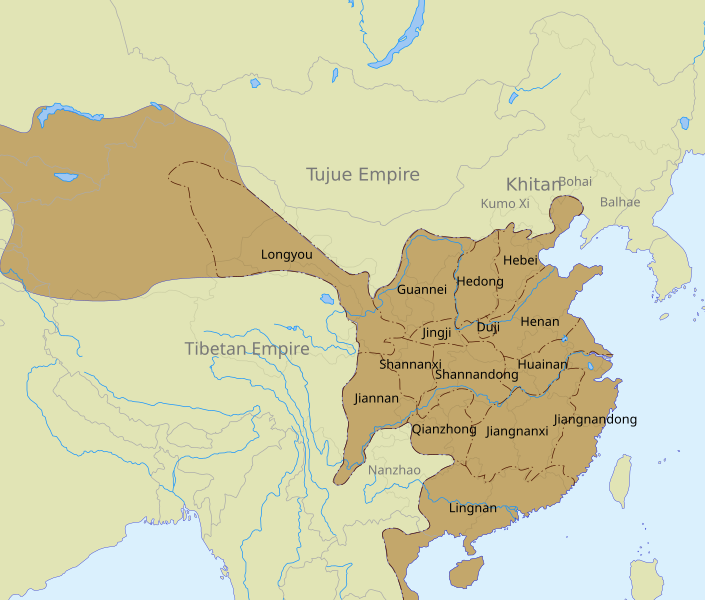
File:China, 742.svg
The conquest strengthened Tang rule over modern Xinjiang, administered by the Anxi Protectorate, and led to Tang suzerainty over the regions previously under the control of the Western Turks.[21] The fall of the Khaganate brought the Altai Mountain region under Tang control and the residing Three Qarluq tribes were governed in newly established prefectures led by tribal chiefs, now commander-in-chiefs under the Tang.[29] Another prefecture, the Jinman Bridle Prefecture, was created for the Chuyue tribes living in the southern Dzungar basin.[19] The Amu Darya valley, the Tarim Basin, and the area beyond the Pamir Mountains, all former suzerains of the Western Turks, were placed under Tang control.[25]
Su continued his career as military general, and later commanded Tang forces in a war against Baekje in 660.[16] The Tang Dynasty achieved its maximum extent following its conquest of the Khaganate.[30] The inhabitants of the new territory did not become sinicized like many of the other kingdoms and tribes conquered by the Tang.[31] Tang military activity in Central Asia brought in a wave of Turkic migrants serving in the Tang military as soldiers and generals, leading to the spread of Turkic language and culture.[32] At the same time, the prevalence of Indo-European languages in the Western Regions was on the decline.[9] Central Asia also absorbed cultural influences from Tang China. Central Asian art incorporated Tang stylistic features, like the sancai three color glaze used in pottery.[33] Chinese coins remained in circulation in Xinjiang after the decline of the Tang.[34] Cultural remnants of Tang architectural influence are still visible in the Buddhist architecture of Dunhuang, on the border between the Western Regions and the Hexi Corridor.[8]
The sheer size of the newly conquered lands made it difficult to govern through the Tang military garrisons.[25] The Tang emperor Gaozong appointed two puppet qaghans to rule over the Western Turks, who were later overthrown in a rebellion that began in 662. The revolt reduced Tang's western extent to BeshbalikDzungaria in northern Xinjiang and ended direct Tang control of Central Asia beyond the Pamir Mountains in modern Tajikistan and Afghanistan. The expansion of the Tibetan Empire from the south threatened China's hold on southern Xinjiang.[30] Tibet invaded the Tarim Basin in 670, but Tang forces regained the area in 693 and Kashgar in 728, restoring the Anxi Protectorate and Four Garrisons. The conflict between Tibet and the Tang continued for the remainder of the Tang Dynasty.[35]
At its maximum extent, Tang expansion brought China into direct contact with the rising Umayyad Caliphate. China's western borders reached the eastern frontier of the Caliphate.[30] Following the Arab defeat of Sassanid Persia in 651, the Caliphate began its expansion into Central Asia, competing with the Tang's sphere of influence in the region. Chinese and Islamic troops finally clashed at the Battle of Talas in 751.[36] The Chinese lost against the Arabs, now under Abbasid rule, and the Arab army captured Chinese papermaking craftsmen. An Arabic record of the conflict claims that the battle led to the introduction of papermaking to the Islamic world